Date and time
June 20, 2025
Koko päivä
 Midsummer Bonfires in Seurasaari
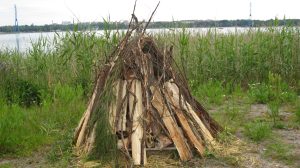
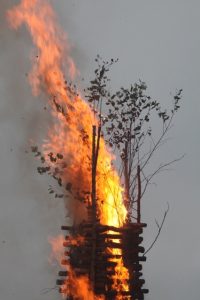
This year, the Seurasaari Foundation will build six traditional midsummer bonfires for the annual Midsummer Festival: a four-legged “sanka” bonfire, a wagon wheel bonfire, the “old maid” bonfire, a large main bonfire, a children’s spruce branch bonfire, and a small raft bonfire set afloat on the sea. Despite tighter regulations, organizing Midsummer celebrations remains a living tradition across Finland, and the lighting of bonfires is still one of the most cherished rituals of Midsummer Eve. Bonfires are typically lit near water, on rocky cliffs, or on hilltops. In some areas, traditional bonfire sites are even named after the occasion, such as “bonfire hills.” However, bonfires are not lit during forest fire warnings.
The Seurasaari Foundation follows detailed instructions for building these bonfires, based on archival research conducted in the 1970s. This year, the bonfires will be constructed by three generations of the same family—an impressive continuity, as the eldest member has been involved in Seurasaari events for over 50 years.
In Koivisto and the Karelian Isthmus, tall “sanka” bonfires and “old maid” bonfires were built, often decorated with tar barrels and birch branches. In Ingria, wheel-shaped bonfires were burned, imagined to spin wildly in the flames. In Muolaa, people used a special firestick called a piruke or pirukki, tipped with birch bark shreds to light the fire. Fire lighting was accompanied by shouts, gunshots, or the sound of shepherd horns.
Jumping over flames and smoke was a common purification ritual. Fires were sometimes lit with friction tools or flint and steel, often by a respected member of the community. Everyone was expected to bring a branch to contribute to the bonfire, symbolizing shared responsibility and collective strength. The term kokko is commonly used in Eastern and Northern Finland, while in Western Finland, names such as tulit, valkea, valkia, or valo were used.
The bonfires are lit at 9 pm – 10 pm if there’s no wildfire warning.
The Birth of Fire – A Traditional Incantation
The “Birth of Fire” is an ancient oral incantation that explains how fire—both dangerous and vital—became part of human life. The chant has been used in rituals, fire prevention, and healing, presenting fire as both divine and purifying.
1. Striking the Fire
Fire originates from the heavens. It comes as lightning or is struck by divine figures like Ilmarinen or Väinämöinen, or made by humans using tools like flint. Fire is portrayed as a powerful supernatural force, symbolized by a snake or a fiery arrow falling from the sky.
2. Fire Falling and Causing Destruction
The spark falls into the cosmic sea—often represented as a lake—causing turmoil and destruction. A fish swallows the spark, and the burning sensation drives it to swim in pain around shores and islands. The spark may pass from one fish to another.
3. Catching the Fire Fish
People eventually catch the fish using nets. Its belly is cut open, and the fire is retrieved. This moment symbolizes humanity’s mastery over fire—transforming a wild force into a tool for culture and survival.
Legacy of Seurasaari’s Midsummer Bonfires
The Seurasaari Midsummer Bonfires have been held since 1954, making this the 71st celebration. It is one of Finland’s longest-standing Midsummer traditions. Through this event, the Seurasaari Foundation fulfills UNESCO’s goals for protecting cultural and natural heritage, and supports Finland’s national strategy for safeguarding living heritage, guided by the Ministry of Education and Culture. Audience feedback has shown strong support for updating the 2018 Rescue Act to better recognize and preserve Finland’s unique bonfire traditions.
Builder of the bonfires: Väinö Hiltunen and his team.